
 Türkçe
 English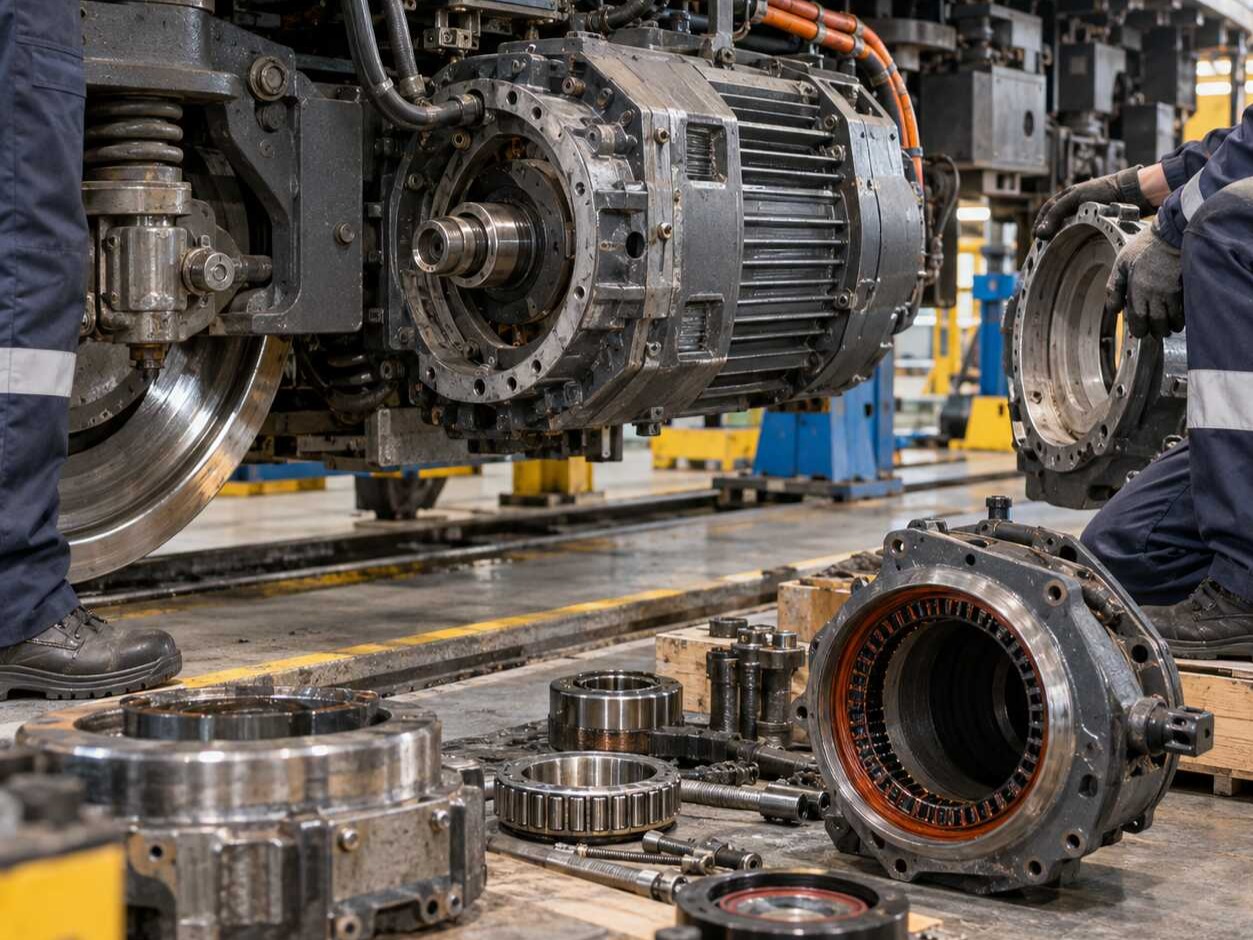
What Is a Traction Motor and What Does It Do?
A traction motor is one of the main drive components that converts electrical energy into mechanical motion to move a locomotive. It plays an important role in generating tractive effort, enabling acceleration, and delivering performance suited to different operating conditions in railway transport. Understanding how a traction motor works and what its main components do helps with selecting the right equipment among locomotive parts and planning maintenance.
In electric locomotives, traction motors run on power supplied by the vehicle's electrical system. In diesel-electric locomotives, a generator or alternator driven by the diesel engine produces that power. In both systems, the motor converts electrical energy into rotation and helps transmit that motion through the drivetrain to the wheels. This produces the tractive force required to move the locomotive along the rails.
How a Traction Motor Works
A traction motor works by generating rotational motion through electromagnetic interaction. The interaction between the magnetic field inside the motor and the electric current produces torque. The motor's rotating components and suitable transmission elements then deliver this torque to the wheel system.
The basic operating process consists of these stages:
- Supplying electrical energy: The locomotive's power system supplies or generates electricity and delivers it according to the motor's operating requirements.
- Generating electromagnetic torque: Interaction between the motor's electromagnetic components produces the torque that drives rotation.
- Transmitting motion: The motor's mechanical output is transferred to the wheel system through a drivetrain suited to the locomotive's design.
- Producing tractive force: Contact between the wheels and rails creates the force that moves the locomotive.
Why Traction Motors Matter in Railway Transport
Traction motors do more than move a locomotive. They also play a key role in managing traction performance, accommodating different load conditions, and supporting continuous operation. Coordinated operation of the motor's mechanical and electrical components helps the drivetrain perform reliably.
Wear, connection problems, or electrical faults in a traction motor can adversely affect locomotive performance. Its overall condition should therefore be assessed as part of the complete system during maintenance and overhaul. Regular inspections help identify potential issues early and plan maintenance more accurately.
In short, the traction motor is the component that converts a locomotive's electrical energy into usable tractive power. Understanding the functions of parts such as the motor housing, armature shaft, and bearings is also important when assessing the efficiency and reliability of the traction system.
Where Is the Traction Motor Located in a Locomotive?
The traction motor is one of the main components that converts electrical energy into mechanical motion in a locomotive's drive system. Depending on the locomotive's design and traction system, it is generally mounted on the bogie, close to the wheelsets. The bogie is the undercarriage that supports the locomotive body and carries the wheelsets. The motor's position within this assembly directly affects how its torque is transmitted to the wheels.
The location of traction motors in electric and diesel-electric locomotives varies according to the vehicle's mechanical design, drivetrain arrangement, and maintenance requirements. Some systems secure the motor to the bogie frame, while other designs use special mounting arrangements that connect it mechanically to the axle. The motor's location should therefore be considered together with the mechanical equipment connected to it.
How the Traction Motor Relates to the Bogie
In addition to supporting the locomotive's weight, the bogie guides the wheels along the rails and helps manage forces generated during motion. The motor's position on the bogie is important both for transmitting tractive force to the wheels and for supporting the motor mechanically.
The relationship between the traction motor and bogie can be considered through three main elements:
- Motor mounts: Mounting components suited to the motor's design keep it in its intended position during operation and transfer forces to the supporting structure.
- Power transmission: Gears and other mechanical connections transmit the torque generated by the motor to the wheelset.
- Mechanical supports: Bearings and other supporting components help rotating parts stay correctly positioned and allow motion to continue reliably.
Power Transmission from the Motor to the Wheels
For a locomotive to move, the torque generated by the traction motor must reach the wheel system. Depending on the drivetrain, this takes place through gear mechanisms and various mechanical connections. The transmission system delivers the motor's rotation in a form that enables the wheels to generate tractive force.
The motor's mounting arrangement, support for rotating components, and compatibility between mechanical parts all matter during power transmission. Loose connections, wear, or alignment issues can cause vibration and uneven load distribution. Maintenance should therefore include checks of the motor's mechanical relationship with the bogie and drivetrain, as well as its electrical condition.
How Motor Location Affects Maintenance and Overhaul
The motor's position in the locomotive affects access, removal, and installation procedures. Its mounting points, bearings, transmission components, and surrounding equipment should be considered together when planning maintenance. During an overhaul, knowing how the motor is mounted on the vehicle helps identify the appropriate parts.
Motor housings, bearing arrangements, and mechanical connections can vary by vehicle model, so technical compatibility is a key criterion when selecting spare parts. Parts that do not match the motor's location and connection specifications can cause installation problems or mechanical incompatibility during operation.
The traction motor's location is more than a physical mounting point. The way it works as a system with the bogie, wheelset, and power transmission components is fundamental to traction performance and maintenance.
What Does a Traction Motor Housing Do?
The traction motor housing is a key structural component of the electric motor used in a locomotive's traction system. It surrounds the motor's internal mechanism and supports the installation of various components, helping preserve the motor's mechanical integrity. Its design varies according to the motor type, operating principle, and locomotive drivetrain.
Traction motors in railway vehicles are exposed to vibration, mechanical loads, and changing operating conditions. The traction motor housing should therefore be viewed as more than an outer cover. It helps keep internal components in position, supports mechanical connections, and contributes to the structural integrity of the system.
Main Functions of the Traction Motor Housing
The housing provides a structural foundation that supports motor components and enables them to work together. The relative positions of the motor's electromagnetic and mechanical parts are important for generating and transmitting motion correctly.
The housing's main functions include:
- Maintaining structural integrity: It supports stationary motor components and helps withstand mechanical forces generated during operation.
- Protecting internal components: It helps shield parts inside the motor from physical impacts originating outside the assembly.
- Providing mounting points: It helps position bearings, covers, and other connection components correctly.
- Maintaining component alignment: It helps preserve the required alignment between stationary and rotating components.
- Transferring mechanical loads: It helps transmit forces generated during operation through the connections to the supporting structure.
How the Housing Relates to Internal Components
A traction motor consists of electrical and mechanical components designed to work together. The housing is one of the structures that supports their arrangement. The relative positions of the armature shaft, bearings, and motor covers are particularly important for smooth rotation.
Deformation or alignment issues on the housing's connection surfaces can affect the operating conditions of rotating parts. This can lead to vibration, uneven wear, and mechanical stress. The housing and its connected components should therefore be assessed together during motor maintenance.
Housing Inspections During Maintenance and Overhaul
Maintenance and overhaul inspections assess the housing's overall physical condition, mounting points, and compatibility with other parts. Damage to the housing can affect the motor's mechanical integrity and the operation of connected components. Inspections should therefore go beyond visible exterior surfaces.
Key inspection points during an overhaul may include:
- Housing integrity: Inspecting for cracks, breaks, deformation, and other signs of physical damage.
- Connection surfaces: Checking mounting areas for wear, damage, or incompatibility.
- Bearing seats: Checking the physical condition and fit of the areas where bearings are installed.
- Covers and fasteners: Assessing mechanical compatibility with the motor's other components.
Following these inspections, the housing's serviceability should be determined in line with the manufacturer's maintenance instructions and applicable technical criteria. Not every physical defect requires replacement. Where structural integrity is affected, however, an appropriate repair or replacement method must be selected.
Why Is It Important to Choose the Correct Housing?
Traction motor housings do not necessarily share the same connection specifications across all locomotive and motor models. Mounting arrangements, bearing seats, and compatibility with other motor components are key factors when selecting the correct part.
An incompatible housing can cause installation problems or mechanical stress during operation. Spare-part procurement should therefore be based on the locomotive model, traction motor type, existing part number, and technical specification.
Ozar Group supplies traction motor housings for locomotive maintenance and overhaul. To identify a suitable part, contact the company with the vehicle type, part number, or technical specification.
Armature Shaft and Motor Torque Transmission
The armature shaft is a key component in traction motors with an armature, transmitting rotational motion to the mechanical drivetrain. The armature is the part involved in the motor's electromagnetic energy conversion and, in DC motors, is generally the rotating assembly. The traction motor armature shaft mechanically supports this assembly and helps transfer the motor's torque to the transmission components.
For a locomotive to move, the torque produced by the traction motor must be transmitted appropriately to the wheelset. Torque is the turning effect that causes a shaft to rotate. The armature shaft carries this mechanical effect from the motor's rotating components to the drivetrain, contributing to the operation of the traction system. Its physical integrity, fit with the bearings, and connection surfaces are important for continuous power transmission.
Main Functions of the Armature Shaft
The armature shaft is more than a rotating connector. It provides a functional link between the motor's electromagnetic assembly and the mechanical drivetrain. Smooth transmission of rotational motion depends on the shaft working in coordination with the components connected to it.
- Transmitting torque: It transfers torque generated by electromagnetic interaction to the mechanical transmission components.
- Supporting the armature: It helps keep the rotating motor components in position and moving together.
- Supporting the bearing system: Its connection to the bearings helps maintain the correct axis of rotation.
- Connecting to transmission components: Depending on the motor design, it transmits mechanical motion through gears and other connections.
Transmitting Motor Torque to the Wheelset
Mechanical torque generated by the traction motor reaches the wheelset through the locomotive's drivetrain. In suitable motor designs, the armature shaft is one of the starting points in this transmission path. Gears transfer the shaft's rotation to the wheel axle, helping the locomotive generate tractive force on the rails.
Compatibility between transmission components is important throughout this process. Wear, misalignment, or mechanical deformation on shaft connection surfaces can adversely affect drivetrain operation. Gear connections and bearing seats should be assessed together to ensure regular torque transmission.
How the Armature Shaft Relates to the Bearing System
The armature shaft must be properly supported to rotate as intended. Bearings provide this support, helping maintain the shaft's axis of rotation and withstand mechanical loads during operation.
Wear or alignment problems in the bearing system can directly affect shaft operation. Likewise, damage to the shaft surfaces that contact the bearings can make it difficult for the bearings to work correctly. The armature shaft and bearing components should therefore be assessed together during maintenance and overhaul.
Armature Shaft Inspections During Maintenance and Overhaul
During a traction motor overhaul, inspectors assess the armature shaft's physical condition, connection areas, and mechanical fit with the bearings. Surface damage or geometric distortion can affect motor performance. Inspections should follow the maintenance instructions and technical requirements for the motor in question.
Key points to assess during an overhaul may include:
- Shaft surfaces: Inspecting for wear, scoring, cracks, and other signs of physical damage.
- Bearing contact areas: Checking the suitability of the shaft surfaces that contact the bearings.
- Gear connections: Assessing connection areas for wear or mechanical incompatibility.
- Straightness and alignment: Checking for geometric distortion that could affect the shaft's axis of rotation.
- Connected components: Inspecting the mechanical relationship between the armature, bearings, and transmission components.
Technical assessment should determine whether the shaft remains serviceable, needs repair, or must be replaced. Damage affecting mechanical integrity should be considered in the context of the complete system, since it can also adversely affect other motor components.
Why Technical Compatibility Matters When Selecting an Armature Shaft
Armature shafts can have different connection and mounting specifications depending on the traction motor type and manufacturer's design. Selecting a shaft based only on its general appearance is not sufficient. It must be compatible with the existing motor assembly, bearing system, and transmission components.
Ozar Group supplies traction motor armature shafts for locomotive maintenance and overhaul. To identify a suitable part and plan procurement, contact the company with the vehicle type, traction motor model, part number, or technical specification.
What Does a Traction Motor Bearing Do?
A traction motor bearing supports the rotating components of locomotive traction motors and helps ensure controlled mechanical movement. Reliable rotation during operation depends on the shaft and bearing components working together. The traction motor bearing is therefore one of the key components for preserving the motor's mechanical integrity and reliable operation of the traction system.
In service, locomotive traction motors are exposed to mechanical forces and vibration caused by rotation. Depending on the motor design, the bearing system helps withstand these forces and keep rotating parts in the correct position. Bearing condition, contact surfaces, and lubrication should all be assessed during traction motor maintenance and overhaul.
How Does a Traction Motor Bearing Work?
Traction motor bearings are used in different arrangements depending on the motor design. Their basic function is to support moving components while allowing rotation under suitable conditions. Depending on the bearing type, the design may use plain or rolling-element bearings.
The main functions of the bearings include:
- Supporting rotating parts: They help keep the motor shaft in position and allow it to rotate smoothly.
- Withstanding mechanical loads: They help transfer forces generated during operation to the motor's supporting components.
- Maintaining alignment: They help preserve the shaft's correct axis of rotation.
- Managing friction: Suitable bearing and lubrication conditions help control friction between moving parts.
- Supporting stable operation: By helping mechanical components work together, they help reduce the risk of irregular motion and vibration.
How the Bearing Relates to the Armature Shaft
In traction motors with an armature, the armature shaft transfers torque generated by electromagnetic interaction to the mechanical drivetrain. Bearing support enables the shaft to maintain the correct axis of rotation during operation. The armature shaft and bearings are therefore interdependent components in the motor's mechanical system.
Clearance, wear, or alignment problems in the bearing system can adversely affect shaft operation. Damage to the shaft's bearing surfaces can likewise prevent the bearings from functioning correctly. Inspections during an overhaul should therefore include the shaft's associated contact areas as well as the bearings.
Signs of Traction Motor Bearing Wear or Faults
Traction motor bearings can wear over time depending on operating conditions and maintenance. Insufficient lubrication, mechanical stress, contamination, or alignment issues in connected components can adversely affect the bearing system. These conditions may produce signs in the motor's overall mechanical performance.
Potential signs of bearing-related problems include:
- Unusual noise: Mechanical sounds that differ from the motor's normal operating characteristics.
- Changes in vibration: A change in vibration levels caused by irregular movement of rotating components.
- Signs of excessive heat: Temperature behavior that differs from normal operating conditions due to friction or lubrication problems around the bearing.
- Surface wear: Physical deterioration on the bearing or connected shaft surfaces.
- Lubrication problems: Deterioration, leakage, or contamination of the lubricant.
These signs do not, by themselves, confirm a bearing failure. Similar symptoms may also originate in other motor components. Diagnosis should therefore be based on inspections performed in accordance with the manufacturer's maintenance instructions and, where necessary, a detailed technical assessment.
Checking Bearings During Maintenance and Overhaul
Inspecting the bearing system during a traction motor overhaul is important for assessing the operating condition of rotating parts. The inspection should consider the bearing's physical condition, connection areas, lubrication, and related shaft surfaces together. This makes it possible to assess not only a problem observed in the bearing but also related mechanical factors that may have caused it.
Whether bearings can be reused or need replacement should be determined in accordance with the technical documentation for the motor. When replacement is required, correct installation, compatibility, and lubrication requirements help ensure reliable operation.
Technical Compatibility When Sourcing Traction Motor Bearings
Traction motor bearings can vary according to the motor design, bearing arrangement, and connected components. Selection should not be based solely on the part's general appearance or intended use. The traction motor model, bearing type, and technical specifications defined by the manufacturer should all be considered.
Ozar Group supplies traction motor bearings for locomotive maintenance and overhaul. To identify a suitable part and assess technical compatibility, contact the company with the vehicle type, traction motor model, part number, or technical specification.
Which Parts May Be Replaced During an Overhaul?
A traction motor overhaul is a maintenance and renewal process in which the mechanical and electrical components of the locomotive's traction motor are inspected in detail. The motor's overall operating condition is assessed, signs of wear or damage are investigated, and parts that do not meet technical requirements are identified. The main objective is to support reliable motor operation and preserve compatibility between connected mechanical and electrical components.
Parts replaced during an overhaul may vary according to the motor type, service history, physical condition, and manufacturer's maintenance instructions. Not every component needs to be renewed during every maintenance procedure. Replacement decisions should be based on inspection findings, technical assessments, and the maintenance requirements for the motor.
Key Parts Inspected During a Traction Motor Overhaul
Traction motors include components that convert electrical energy as well as parts that support and transmit mechanical motion. Since these components affect one another during operation, overhaul work should address the integrity of the complete system.
Parts that may be assessed for repair or replacement include:
- Traction motor housing: The housing is checked for cracks, deformation, damage to connection surfaces, and mounting incompatibilities. Repair or replacement may be considered according to its structural condition.
- Armature shaft: In motors with an armature, the shaft is checked for surface wear, geometric distortion, and damage around connection areas.
- Motor bearings: Bearings that support rotating parts are assessed for wear, excessive clearance, physical damage, and deterioration in operating conditions.
- Electrical components: Depending on the motor type, windings, insulation, and electrical connections are inspected. Components that do not meet requirements may need repair or replacement.
- Brushes and commutator: In DC traction motors that use these components, wear, surface condition, and electrical contact are inspected.
- Connections and fasteners: Components used to mount the motor are checked for looseness, deformation, and physical damage.
When the Motor Housing May Need Repair or Replacement
The traction motor housing helps maintain the mechanical arrangement between stationary and rotating components. Damage around its connections can affect the bearing arrangement and the motor's overall mechanical integrity. Housing surfaces, connection points, and bearing seats should therefore be assessed carefully during an overhaul.
Not every defect found on the housing means it must be replaced. Appropriate repairs may be considered following a technical inspection. Replacement may be necessary, however, when damage affecting structural integrity or compatibility with other components cannot be corrected using an acceptable method.
Assessing the Armature Shaft and Bearings Together
The armature shaft and bearing system are complementary mechanical parts that enable the motor's rotating components to work smoothly. Wear on the shaft's bearing surfaces can affect bearing operation. Likewise, bearing deterioration can place additional mechanical stress on the shaft.
Inspecting only the part that appears damaged may therefore be insufficient. Assessing the shaft surfaces, bearings, and related mounting areas together helps identify the source of a fault. Correct installation and alignment after replacement are also important stages of maintenance.
Electrical Component Repair and Replacement
The electrical components of a traction motor directly support the conversion of electrical energy into mechanical motion. Depending on the motor type, windings, insulation systems, electrical connections, and current-carrying components may be inspected during an overhaul. Deterioration in these parts can adversely affect the motor's electrical operation.
Electrical inspections assess insulation condition, connection integrity, and the general suitability of the relevant components. Any repair or replacement identified as necessary should be planned in accordance with the motor design and the manufacturer's instructions.
How Are Replacement Parts Identified During an Overhaul?
Correctly identifying parts for replacement helps prevent unnecessary renewal and makes effective use of maintenance resources. Decisions should be based on the results of relevant technical inspections, not solely on visible wear.
A general traction motor overhaul may include these stages:
- Initial assessment: The motor's service history, reported faults, and maintenance records are reviewed.
- Disassembly and cleaning: Relevant motor components are removed in accordance with the manufacturer's instructions and prepared for inspection.
- Mechanical inspections: The housing, shaft, bearings, and fasteners are assessed for wear or damage.
- Electrical inspections: Electrical examinations and tests appropriate to the motor type are carried out.
- Part assessment: Components that can be reused, repaired, or need replacement are identified.
- Assembly and verification: After the required work is complete, the motor is assembled according to technical instructions and the relevant checks are performed.
Why the Right Spare Parts Matter During an Overhaul
Spare parts used in a traction motor overhaul must be compatible with the existing motor design. Parts serving the same function may differ in their connections, installation, and operating characteristics across motor models. Selecting a part by product name alone can therefore increase the risk of technical incompatibility.
Overhaul planning should take into account the motor model, identifying information for the existing part, and the technical specification. When multiple components need replacement, their compatibility with one another should also be assessed. This helps ensure that installation is planned correctly and that the motor's compliance with its intended operating conditions can be verified after maintenance.
Ozar Group supplies traction motor parts needed for locomotive maintenance and overhaul. To identify suitable spare parts, contact the company with the vehicle type, traction motor model, part number, or technical specification.
What Information Is Needed When Requesting Traction Motor Parts?
Identifying the correct product is important for effectively planning locomotive maintenance and overhaul. Traction motors can have different mechanical connections, electrical specifications, and mounting arrangements depending on the locomotive type and manufacturer's design. When requesting components such as a traction motor housing, armature shaft, or bearing, the system in which the part will be used must be clearly identified.
For railway spare parts, specifying the product name alone is not always sufficient. Parts with the same function can differ in their technical specifications and connections across motor models. Providing the vehicle type, traction motor model, part number, and technical specification helps assess whether the requested product is compatible with the existing system.
Key Information for a Traction Motor Spare-Part Request
Providing clear technical information supports accurate part identification. Identifying the existing part correctly is especially important during maintenance and overhaul when suitable product alternatives are being evaluated.
Recommended information to include in a part request:
- Locomotive type and model: Identifies the railway vehicle for which the part is intended. Whether the locomotive has an electric or diesel-electric traction system can also help identify the relevant motor.
- Traction motor manufacturer and model: Helps identify the motor's technical design and the components it uses.
- Part number: The manufacturer's part code is one of the main references for matching the requested component.
- Technical specification: Describes the technical and functional requirements the part must meet.
- Part name and location: Explains the requested product's function within the motor and the system to which it connects.
- Technical drawing or product image: Can help identify the existing part and compare its connection specifications.
- Required quantity: Clarifies the number of parts needed for the maintenance or overhaul scope.
Why Specify the Locomotive and Traction Motor Model?
The technical design of locomotive traction motors varies according to the vehicle's drivetrain and the manufacturer's design. Housing connections, shaft arrangements, bearing systems, and electrical components may differ between motor models. Correct part selection therefore requires the identifying information for the traction motor as well as the locomotive model.
Accurately identifying the motor model is especially helpful for parts such as the traction motor housing and armature shaft, where mechanical compatibility is essential. It allows potential installation incompatibilities to be assessed in advance and supports selection based on the existing equipment's technical requirements rather than a general product description.
Why Part Numbers and Technical Specifications Matter
A part number is an important reference for identifying a component defined by its manufacturer. Sharing the number of the part required for maintenance or overhaul makes it easier to match the correct product among similar parts with different designs.
A technical specification describes a part's operating conditions, connection requirements, and expected characteristics. If the part number is unavailable, the product may be assessed using existing technical drawings, motor information, and relevant documents. Sufficient identifying information is still needed to verify technical compatibility.
Part Requests for Maintenance and Overhaul
A traction motor part may be requested for scheduled maintenance or to meet replacement needs identified during an overhaul. Scheduled maintenance may require parts identified in advance, while additional requirements may arise after disassembly and technical inspection during an overhaul.
It is helpful to specify the maintenance or overhaul scope when submitting a request. If several connected parts are to be replaced, the motor housing, armature shaft, and bearing components should be assessed together. This allows their compatibility within the system to be considered, not just the suitability of each part on its own.
How Accurate Part Identification Supports Procurement
Providing complete technical information helps organize product assessment and define the scope of procurement. Incomplete or unclear descriptions can require additional technical information and extend the matching process.
Accurate part identification also supports maintenance planning and reduces the risk of mixing components from different motor models. Evaluation based on technical documentation is especially important in systems such as traction motors, where multiple mechanical and electrical components work together.
Traction Motor Spare Parts from Ozar Group
Ozar Group supplies spare parts such as traction motor housings, armature shafts, and bearings for locomotive maintenance and overhaul. Providing technical information with a part request helps identify a product compatible with the existing equipment and plan procurement correctly.
Correct identification, technical compatibility, and system integrity are essential when sourcing traction motor spare parts. To assess a suitable part, contact Ozar Group with the vehicle type, traction motor model, part number, or technical specification.